Why we invested in Array Labs: Scaling 3D Earth Observation with Radar
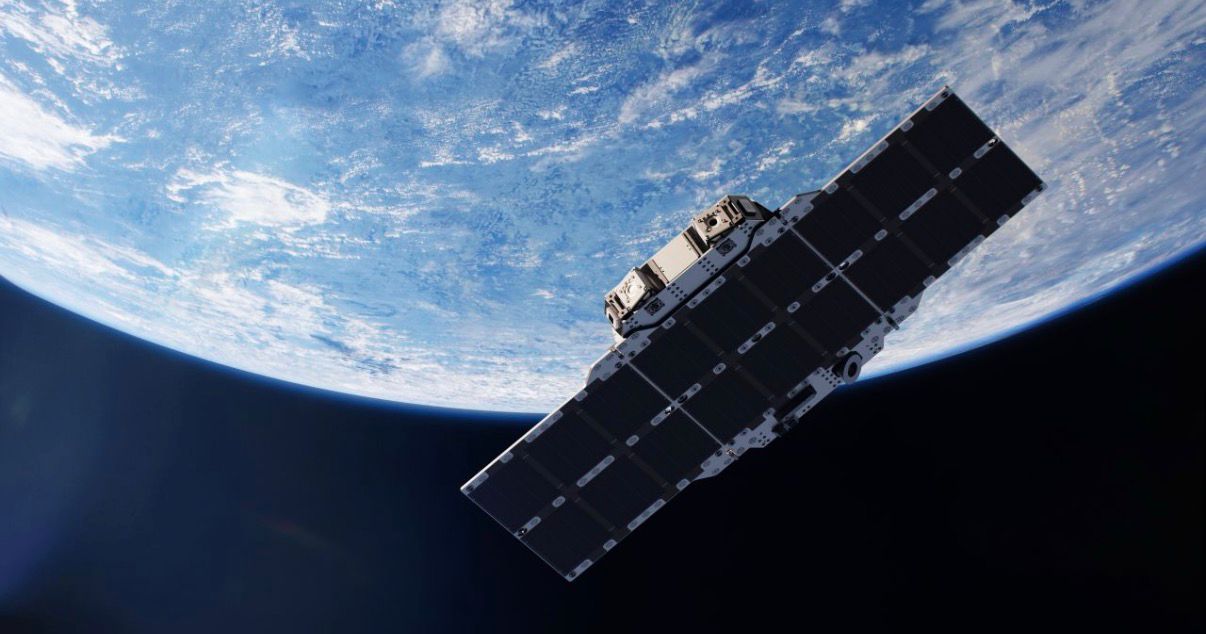
Earth observation is a foundational input for decisions across infrastructure, industry, defence, and climate. Yet much of today’s data is constrained by the limits of optical sensing - cloud cover, revisit rates, and latency remain persistent challenges, particularly for three-dimensional mapping. Radar offers a clear technical alternative, but legacy radar satellites have historically been expensive, bespoke, and difficult to scale.
Our investment in Array Labs’ Series A reflects our belief that advances in radar and manufacturing are reshaping what satellite data can deliver. Array’s space-based radar systems, designed for scale, performance, and cost efficiency, open up new categories of applications across industry, infrastructure, and environmental monitoring that were previously out of reach.
A Radar Architecture Designed for Scale
Array Labs has developed the first satellite radar architecture that can be mass-manufactured using techniques borrowed from consumer electronics and telecommunications. Instead of treating each satellite as a bespoke aerospace program, Array applies high-volume hardware principles to dramatically reduce cost while increasing capability.
At the core of this approach is a family of radar instruments delivering orders-of-magnitude improvements in power efficiency and output, packaged in form factors compatible with standard small satellites, scaled buses, and next-generation launch platforms. This design allows Array to support a wide range of missions without sacrificing reliability or scalability.
From Constellation Concept to Radar Platform
While Array initially set out to operate its own formation-flying satellite clusters for persistent, real-time 3D Earth mapping, growing customer demand made clear that the radar instruments themselves were the primary point of differentiation.
Today, Array operates across three complementary business lines:
- Radar payloads, sold to satellite manufacturers, operators, and defence primes seeking high-power radar systems that can be integrated quickly and produced at scale.
- Sovereign satellite systems, delivering fully integrated spacecraft and dedicated clusters for customers who want to own and operate radar assets for wide-area ISR and target identification.
- Data products, providing 3D imagery and analytics from Array’s owned and operated radar clusters to commercial, civil, and government users.
This platform strategy allows Array to participate across hardware, systems, and data, while maintaining a shared technological core.
Validation Across Government and Commercial Markets
This step change in radar capability has begun to attract attention across both public and commercial markets. Over the last two years, Array has participated in a number of competitive U.S. government programs to advance core technologies such as high-power antenna architectures, high-bandwidth communications, and 3D reconstruction. These efforts have helped validate the system in demanding operating environments while accelerating technical maturity.
On the commercial side, Array has signed multi-year capacity agreements for its first radar cluster with global leaders in mining, infrastructure, and embodied AI. These customers will use Array’s 3D data and analytics to monitor high-value industrial assets, plan and protect critical infrastructure, and improve ground-truth inputs for autonomous systems. Importantly, these are long-term operational workloads that depend on persistent, reliable capacity rather than ad-hoc imagery.
In parallel, demand for turnkey radar payloads is increasing as satellite operators and industrial partners seek access to high-performance radar without the cost and complexity of bespoke development. Array expects to share further updates as payload deployments expand and production scales.
Why Radar, Why Now
Advances in semiconductors, communications hardware, and onboard processing have fundamentally shifted the economics of radar. Array has focused on integrating these technologies into systems that are cheaper to build, faster to deploy, and easier to integrate, while remaining powerful enough for demanding missions including global detection, tracking, and space domain awareness.
Just as importantly, Array pairs its hardware with software that transforms raw radar returns into actionable 3D intelligence, making radar usable as a recurring operational input rather than a specialist product.
A Team Built for Execution
Array Labs is led by a team with deep experience across radar systems, aerospace engineering, and commercial geospatial platforms. CEO Andrew Peterson brings a background in high-power radar and beam-control systems from major defence programs, complemented by Justin Kroll’s experience spanning Google Maps and Maxar. Collectively, the team has contributed to the launch of hundreds of satellites and has demonstrated the ability to deliver in a technically demanding, capital-intensive domain.
Conclusion
Array Labs is taking a disciplined, hardware-first approach to space-based radar, making high-performance sensing scalable, manufacturable, and commercially viable. By lowering the cost and complexity of persistent 3D Earth observation, Array enables better decision-making across infrastructure, industry, and environmental monitoring.
This directly aligns with KOMPAS’ mission to support technologies that help modernise the manufacturing industry and the built environment sectors, which face mounting pressure from productivity constraints, climate impacts, geopolitical risk, and increasingly complex supply chains. Array’s radar systems provide the foundational data required to operate these systems more efficiently, resiliently, and sustainably.
We’re proud to support Array Labs as they build critical sensing infrastructure that helps industry and governments measure, manage, and transform the physical world in line with both economic and planetary boundaries.
--
written by Andreas Winter-Extra, Operating Partner at KOMPAS VC